
- DAYA Electric Explains the Classification of Cable Distribution Boxes
- 2015/4/9 DAYA Electric
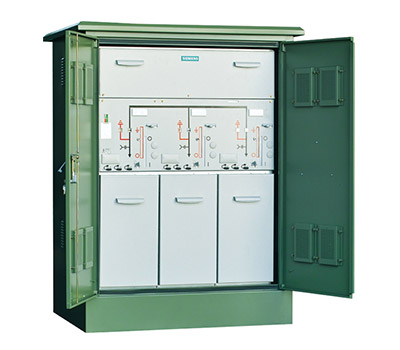 Cable distribution boxes are divided into two categories based on their electrical configuration: one type contains no switching equipment, with only accessories for processing and connecting cable terminations inside the cabinet. It features a simple structure, compact size, and single function, and can be called an ordinary distribution box; the other type not only includes the accessories of an ordinary distribution box but also one or more switching devices. It has a relatively complex structure, large volume, numerous connecting components, high manufacturing technical difficulty, and high cost, and can be called an advanced distribution box.
1. Ordinary Cable Distribution Boxes
Ordinary distribution boxes are not equipped with switching equipment. The incoming and outgoing lines are electrically connected, maintaining the same potential, making them suitable for tapping or branching connections. Conventionally, the total number of branches is calculated by adding the number of incoming circuits to the number of outgoing circuits. For example, a three-branch cable distribution box has three equipotential connection points on each phase, which can be used for one incoming and two outgoing circuits or two incoming and one outgoing circuit. The box contains three phases (U, V, W) with identical circuit structures arranged in sequence.
2. Advanced Cable Distribution Boxes
Advanced distribution boxes are equipped with switching equipment. They not only perform the tapping and branching functions of ordinary distribution boxes but also control and convert power supply circuits, and change operating modes. The switch contacts roughly separate the cable circuit into the incoming side and outgoing side, where the potentials on both sides can differ. Due to the large volume of the switching equipment itself, advanced distribution boxes have larger overall dimensions: the height is generally 1.4–1.8 m, the depth is approximately 0.9–1.0 m, and the length varies depending on the number of switching devices, typically ranging from 1.0 m to 2.4 m. The external shape of the box is similar to an outdoor box-type transformer, with several movable doors on the casing—some designed for operating the switching equipment, and others for the installation, construction, maintenance, or inspection of cable connection components.
This article is edited and organized by DAYA Electric Group Co., Ltd. (https://www.hygraphics.com/). Please indicate the source when reprinting.
- Brief Description of What a High-Voltage Ring Main Unit IsHow to Reasonably Select the Electrical Service Life of Outdoor High-Voltage Vacuum Circuit Breakers
中文版
Service Hotline
:0577-67391666